
What Is a Chargeback on a Debit Card?

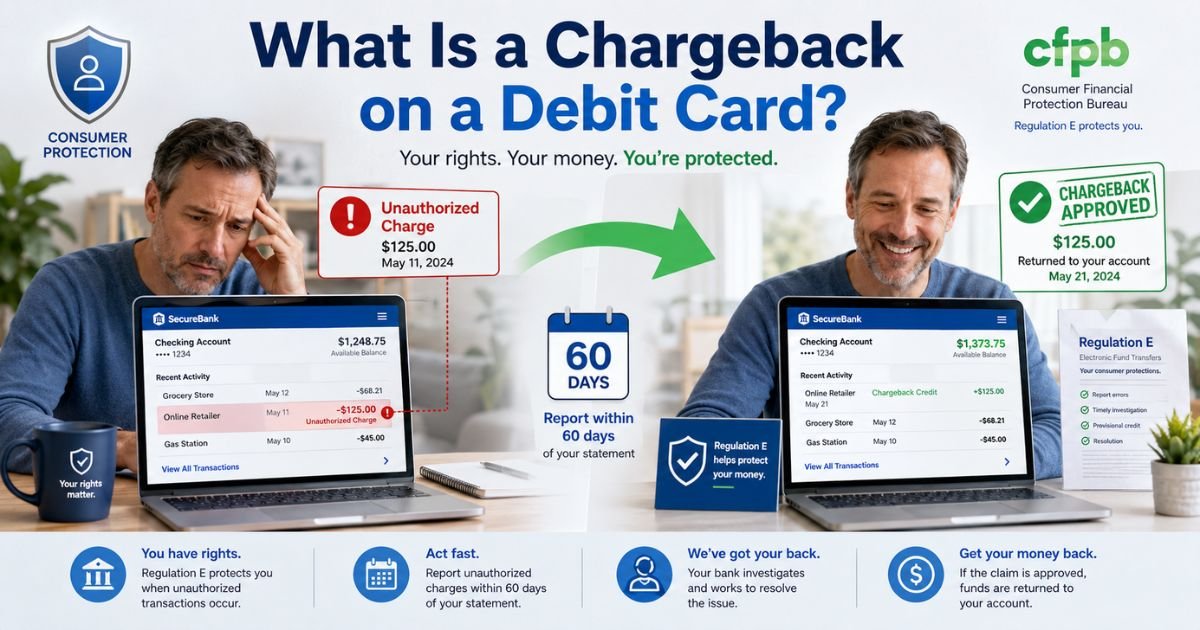
A chargeback on a debit card is one of the most important consumer protections available to everyday Americans. It lets you formally dispute a transaction that has already been deducted from your checking or savings account and request that your bank reverse it when the charge was unauthorized, incorrect, or otherwise erroneous.
Under federal law—specifically Regulation E of the Electronic Fund Transfer Act—your bank has clear obligations to investigate and resolve these disputes fairly and quickly. This guide explains exactly how debit card chargebacks work, how they differ from credit card disputes, the timelines you can expect, success factors, and the precise steps to take if you ever need to file one.
Whether you spotted a fraudulent charge, paid for merchandise that never arrived, or were double-billed, understanding the chargeback process on a debit card empowers you to protect your hard-earned money.
Key Takeaways
- A chargeback on a debit card reverses erroneous or unauthorized electronic fund transfers under Regulation E protections enforced by the CFPB.
- Unlike credit cards, debit card chargebacks immediately affect your actual bank balance, making timely action essential.
- You must notify your bank within 60 days of the statement date that first shows the error to preserve your full rights.
- Banks must investigate most disputes within 10 business days and often provide provisional credit while they review.
- Well-documented disputes—especially for unauthorized transactions—have strong success rates because the burden of proof generally rests with the financial institution.
What Is a Chargeback on a Debit Card?
A chargeback on a debit card (also called an error resolution or dispute under Regulation E) occurs when you ask your bank to investigate and reverse a transaction that posted to your account. The bank then debits the merchant’s account and credits your account if the claim is valid.
Regulation E covers most debit card transactions, ATM withdrawals, and other electronic fund transfers. Covered “errors” include:
- Unauthorized electronic fund transfers (the most common reason people file)
- Incorrect amounts or dates
- Transactions omitted from your statement
- Computational or bookkeeping mistakes by the bank
- Goods or services not delivered as agreed
- Requests for additional documentation
This process is distinct from a simple merchant refund. A chargeback is a formal, regulated procedure that does not require the merchant’s cooperation in most cases.
Debit Card Chargeback vs. Credit Card Chargeback: Key Differences
Many people assume the processes are identical, but they are governed by different federal rules and have very different practical effects on your finances.
| Aspect | Debit Card (Regulation E) | Credit Card (Regulation Z) |
|---|---|---|
| Funds Impact | Money is immediately removed from your checking account | Creates a debt; no immediate cash outflow |
| Notification Deadline | 60 days after statement reflecting the error | 60 days after statement |
| Investigation Timeline | 10 business days (extendable to 45–90 days with provisional credit) | Up to 90 days (2 full billing cycles) |
| Provisional Credit | Usually required within 10 business days | Not always provided the same way |
| Liability for Unauthorized Use | $50 if reported in 2 business days; $500 within 60 days; unlimited after | Typically $0 under most issuers’ zero-liability policies |
| Burden of Proof | Bank must prove you authorized the transaction for fraud claims | Issuer investigates; you provide supporting information |
| Best For | Quick resolution of fraud or clear errors | Larger purchases and “friendly fraud” or quality disputes |
Because debit card chargebacks pull real money from your account, the process includes stronger provisional-credit requirements to protect consumers while investigations occur.
How the Regulation E Dispute Process Works
When you file a chargeback on a debit card, your bank follows strict procedures outlined in 12 CFR § 1005.11:
- You provide oral or written notice of the error (including your name, account number, transaction details, and why you believe it is wrong).
- The bank must acknowledge and begin investigating promptly.
- Within 10 business days, the bank determines whether an error occurred, reports the results to you, and corrects any error within one business day.
- If the bank needs more time, it may take up to 45 calendar days (or 90 days for certain point-of-sale debit transactions or foreign transfers) only if it first issues a provisional credit to your account within the initial 10 business days.
- You receive written explanation if the bank finds no error, and you can request copies of the documents it relied upon.
The bank cannot charge you for the investigation or impose overdraft fees on provisional credits in most cases.
Typical Investigation Timelines and What to Expect
- Standard cases: Most straightforward disputes resolve within 10 business days.
- Complex cases (e.g., point-of-sale debit card transactions or those requiring merchant input): Up to 45–90 days with provisional credit protecting your balance.
- Provisional credit: You usually regain access to the disputed funds while the bank investigates. The bank notifies you of the credit amount and date.
These timelines are designed to balance consumer protection with the bank’s need to gather evidence. The CFPB monitors compliance, and institutions that repeatedly fail to meet deadlines can face enforcement actions.
Chargeback Success Rates and Factors That Influence Outcomes
Industry analyses show that merchants win roughly 45–54% of the chargebacks they contest through representment. From the consumer perspective, however, legitimate debit card chargebacks—especially unauthorized transactions—have high approval rates when reported promptly and supported with clear documentation.
Success is highest when:
- You report quickly (especially within 2 business days for lost/stolen cards).
- You provide specific details and any available evidence (receipts, emails, screenshots, police reports for fraud).
- The reason falls clearly under Regulation E error categories.
- You follow up in writing after any oral notice.
The bank bears the burden of proving you authorized an allegedly unauthorized transfer. This legal advantage, combined with provisional-credit rules, means most well-documented consumer claims are resolved favorably.
How to File a Chargeback on Your Debit Card
Follow these steps to maximize your chances of success:
- Review your statement immediately — Log into your online banking or app as soon as you notice anything suspicious.
- Gather your evidence — Note the exact date, amount, merchant name, and why the charge is wrong. Save screenshots, emails, or receipts.
- Contact your bank right away — Call the number on the back of your card or use the secure message center/app. Explain the situation clearly.
- Follow up in writing — Send a formal dispute letter (many banks provide templates) within 10 business days of any oral notice. Include all details and evidence.
- Request provisional credit — Ask whether the bank will issue one while investigating.
- Monitor your account — Watch for the investigation results (usually within 10 business days) and any requests for additional information.
- Escalate if needed — If denied unfairly, request the documents the bank used, reassert your claim, or file a complaint with the CFPB at consumerfinance.gov/complaint.
Acting fast preserves both your liability limits and your strongest legal position.
FAQs About Chargebacks on Debit Cards
How long do I have to file a chargeback on a debit card?
You have 60 days from the date your bank sends the periodic statement that first reflects the disputed transaction to notify your financial institution. Missing this window can limit or eliminate your rights under Regulation E, so check statements promptly and report errors immediately.
Can I get a chargeback on a debit card for items I never received?
Yes. If a merchant fails to deliver goods or services as agreed, this qualifies as an error under Regulation E. You can dispute the charge directly with your bank after attempting resolution with the merchant when practical. Provide proof of purchase and any communication showing non-delivery.
What happens if my bank denies my debit card chargeback?
You can request copies of all documents the bank relied on to make its decision. If you still disagree, you may reassert the claim or file a complaint with the Consumer Financial Protection Bureau (CFPB). The bank must follow strict procedures; failure to do so strengthens your position.
Is a debit card chargeback the same as a merchant refund?
No. A merchant refund is voluntary and depends on the store’s policy. A chargeback is a formal, regulated process through your bank that can force reversal even if the merchant refuses to cooperate. It is a stronger consumer protection tool when a merchant is unresponsive.
Do I need to contact the merchant before filing a debit card chargeback?
Regulation E does not require you to contact the merchant first for most error types. However, reaching out to the merchant often resolves simple issues faster and provides helpful documentation for your bank dispute. For clear fraud or billing errors, you can go straight to your bank.
How does reporting a lost or stolen debit card affect my liability and chargeback rights?
Reporting within two business days limits your liability for unauthorized use to $50. Reporting within 60 days caps it at $500. Prompt reporting also strengthens any related chargeback claims because it demonstrates you acted responsibly and helps the bank investigate quickly.
Can I dispute recurring subscription charges on my debit card?
Yes. Unauthorized recurring charges or charges that continue after cancellation qualify as errors under Regulation E. Notify your bank with proof of cancellation or that you never authorized the subscription. The bank must investigate and reverse the charges if they were not properly authorized.
Conclusion: Protect Your Debit Card with Confidence
A chargeback on a debit card is a powerful, federally backed right that puts the burden on your bank to investigate and correct errors quickly. By understanding Regulation E timelines, acting within the 60-day window, and documenting everything thoroughly, you give yourself the best chance of recovering your money.
Remember these four essentials:
- Report suspicious activity the moment you see it.
- Follow up oral notices with written confirmation.
- Expect provisional credit in longer investigations.
- Use the CFPB as backup if your bank does not follow the rules.
Take action today: Open your banking app or log into online banking and review your last two statements. If anything looks off, contact your bank immediately—you now have the knowledge to navigate the process successfully.
For more practical guides on debit card fees, fraud prevention, overdraft protection, and your full range of banking rights, explore the rest of ChargeOnDebitCard.com. We’re here to help you make smarter financial decisions every day.
Disclaimer The information in this article is provided for general educational and informational purposes only. It does not constitute legal, financial, tax, or professional advice of any kind. Banking rules, fees, and consumer protections can vary by institution and may change over time. Always verify the most current information directly with your bank, the Consumer Financial Protection Bureau (CFPB) at consumerfinance.gov, or a qualified financial advisor or attorney. ChargeOnDebitCard.com and its authors are not responsible for any decisions you make based on the content of this article. This site is not affiliated with, endorsed by, or sponsored by any bank, card network, or government agency.